
Identity security is the practice of protecting digital identities and controlling how people and devices access systems and data. The concept of identity security combines authentication, access controls, identity governance, continuous monitoring, and threat detection to help ensure that only trusted users and devices can access sensitive resources.
What is a digital identity?
A digital identity is the collection of accounts, attributes, and permissions that identify a person, device, or system online. It determines who or what can access digital resources and what actions they are allowed to perform.
Digital identities aren't limited to people. Devices, applications, service accounts, bots, and AI agents can also have digital identities that allow them to interact with systems and data.. Common examples include email accounts and social media profiles. The identity may extend to workplace logins and cloud services that individuals access.
A digital identity is broader than an individual account. One person may have dozens of accounts across different services. They all come together to form part of that person's overall digital identity.
- Identity security protects digital identities by verifying who can access accounts, applications, systems, and data.
- People, devices, applications, bots, and AI agents all have digital identities that need to be managed and secured.
- Most identity attacks begin with stolen credentials or excessive permissions. This can allow attackers to appear as legitimate users.
- Passkeys, multi-factor authentication (MFA), strong passwords, and least privilege are among the most effective ways to reduce identity-based risks.
- Identity security is an ongoing process. Combining authentication with access control and continuous monitoring is essential to identify suspicious activity.
How is identity security different from identity and access management (IAM)?
Identity and access management (IAM) is the set of processes and technologies used to create digital identities and control access to systems and applications. It focuses on ensuring the right people can access the right resources at the right time.
Identity security builds on these foundations by adding continuous monitoring. This includes a need for ongoing threat detection and incident response. These security measures also help identify compromised accounts and attacks.
IAM is therefore a core part of identity security. It should not be thought of as an alternative to it.
|
Identity and Access Management (IAM) |
Identity Security |
|
Creates and manages digital identities |
Protects digital identities throughout their lifecycle |
|
Authenticates users and controls access |
Monitors identities for suspicious activity and compromise |
|
Grants and removes permissions |
Detects, investigates, and responds to identity-based threats |
|
Focuses on access management |
Combines access management with governance, monitoring, and threat protection |
A comprehensive identity security program typically combines four complementary areas:
- Identity and Access Management (IAM): Creates digital identities and manages access to systems and applications.
- Privileged Access Management (PAM): Protects high-privilege accounts with elevated access to critical systems and sensitive data.
- Identity Governance and Administration (IGA): Helps organizations manage identity lifecycles and access reviews to ensure users have the appropriate level of access at all times.
- Identity Threat Detection and Response (ITDR): Continuously monitors identities for suspicious activity and helps detect and respond to identity-based attacks.
Together, these components help organizations prevent identity-based attacks and respond quickly by changing permissions or revoking access when an account or identity is compromised.
How does identity security work?
Identity security is an ongoing process that protects digital identities before, during, and after they access a system. It does not simply check a username and password at login; it continually verifies identities and monitors activity. The system can respond to suspicious behaviour.
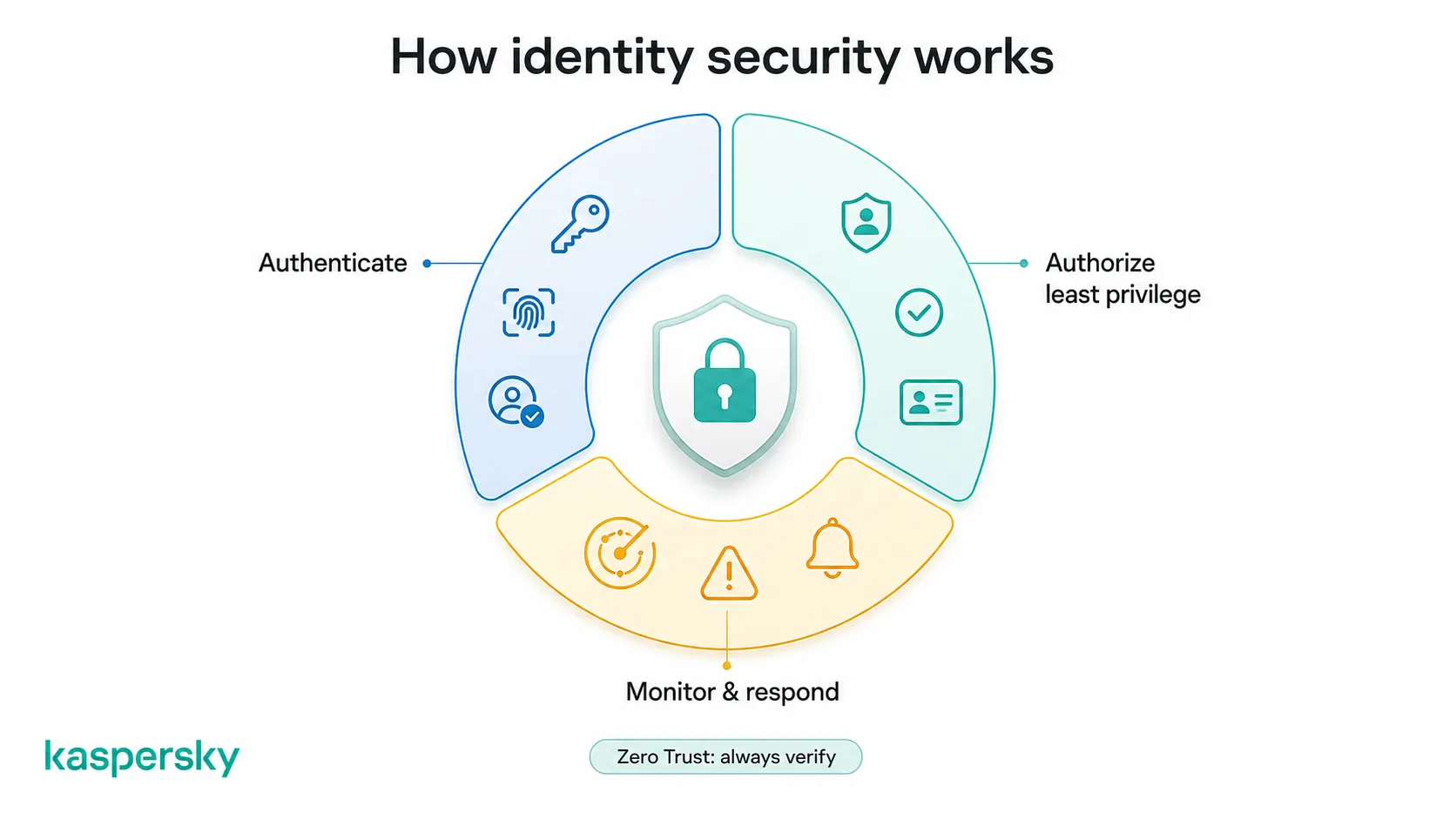
Identity security is built around the idea that trust should never be permanent. A user may successfully sign in from a familiar device one day but the same account attempting to log in from an unfamiliar country or access sensitive data at an unusual time may require additional verification. This approach supports the principles of least privilege (users receive only the access they need) and Zero Trust (which assumes every access request should be verified rather than automatically trusted).
Authentication and access control
Authentication confirms that a user or system is who it claims to be. This may involve passwords, passkeys, biometrics such as fingerprints or facial recognition, or physical security keys. Multi-factor authentication (MFA) adds another layer of protection by requiring two or more verification methods.
Authorization determines what it can access once the identity itself has been confirmed. Identity security follows the principle of least privilege: users and devices receive only the permissions needed to perform their specific tasks. Limiting unnecessary access helps reduce the impact if an account is compromised.
Monitoring and response
Identity security doesn't stop once a user has signed in because authentication alone cannot detect every identity-based attack. It therefore monitors account activity for signs that an identity may have been compromised.
Suspicious activity might be flagged due to a login from an unfamiliar device or at an unusual location. Any abnormal account behaviour can indicate suspicious activity. The system may then request additional verification or block access temporarily or permanently. It may also revoke compromised credentials until the activity can be investigated.
What is identity security posture management (ISPM)?
Identity Security Posture Management (ISPM) is the continuous assessment of identities, permissions, and identity-related risks across an organization's environment.
ISPM helps security teams identify excessive permissions and misconfigured access controls. It can also identify orphaned accounts that no longer belong to active users and detect other weaknesses before attackers can exploit them. ISPM complements identity and access management (IAM) by helping organizations continuously improve the security of their identity infrastructure.
What are the main identity security threats?
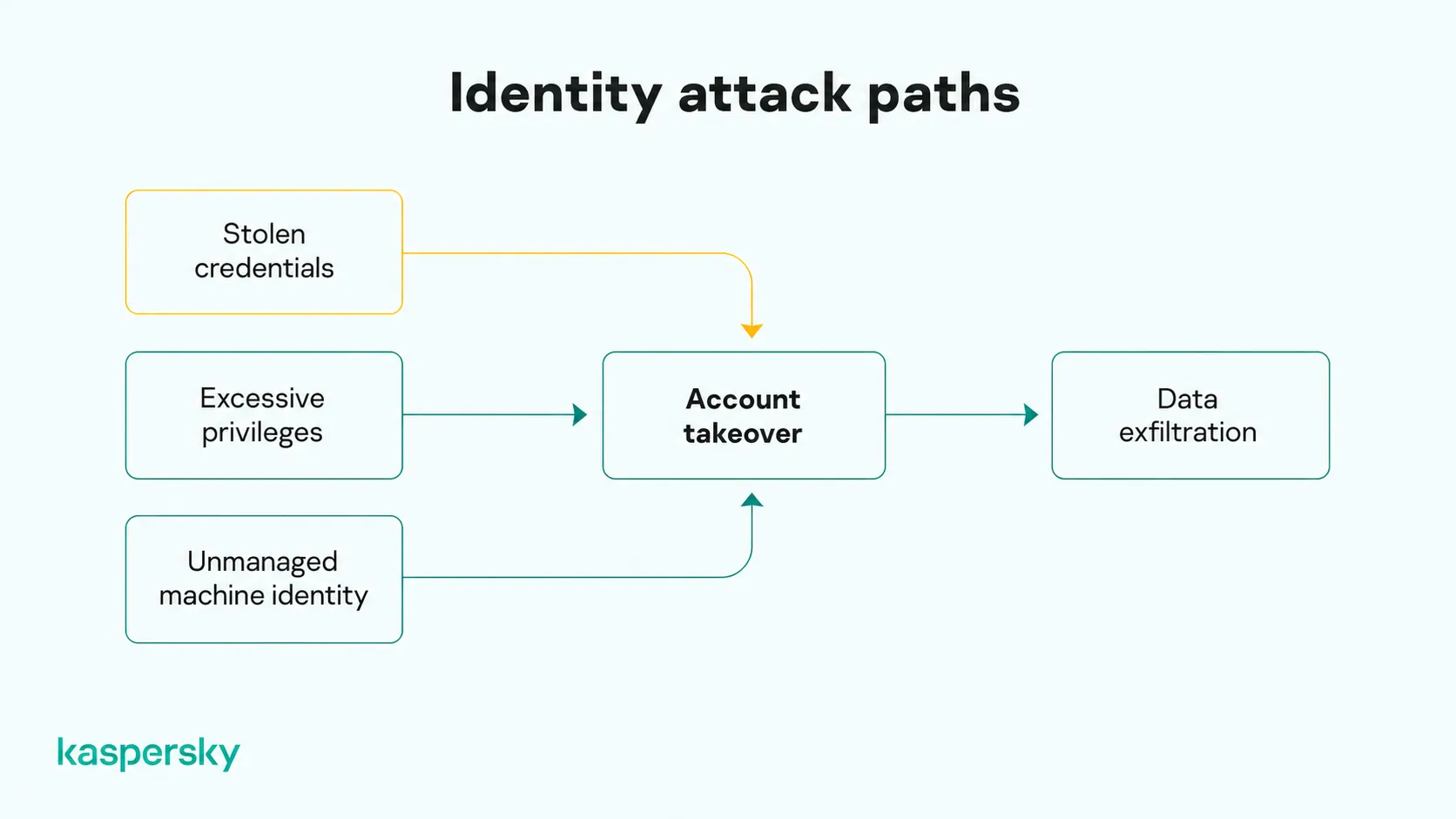
Most identity-based attacks don't rely on breaking into systems. Attackers try to obtain legitimate access or exploit identities that already have more permissions than they need. Understanding these common attack paths helps explain why identity security focuses on verifying identities, controlling access, and continuously monitoring activity.
Stolen credentials and account takeover
Many identity attacks begin with stolen credentials. Cybercriminals may steal usernames and passwords through phishing or use credential stuffing to test leaked credentials across multiple sites. This is especially effective when people reuse the same password for different accounts.
They may also use techniques such as MFA fatigue; users are bombarded with authentication requests until they approve one by mistake. Attackers may also hijack active sessions to bypass the login process altogether.
Once attackers gain authenticated access, their activity may appear to come from a legitimate user. Strong authentication and phishing-resistant login methods can significantly reduce these risks.
Excessive and outdated access
Not every identity threat involves stealing credentials. Sometimes the biggest risk is that users or accounts already have more access than they need. Unnecessary permissions or elevated privileges can be a security risk.
Attackers often try to move through an organization by abusing these permissions to reach more valuable systems and data. Applying the principle of least privilege and regularly reviewing access rights helps limit what a compromised identity can do.
Machine identities and AI agents
People aren't the only identities that need protection. Organizations also rely on service accounts, API keys, automated bots, applications, and increasingly AI agents to perform routine tasks and communicate with other systems.
These non-human identities can also be compromised if they have excessive permissions or unclear ownership. Machine identities should be monitored and managed throughout their lifecycle just like human identities. They should only have the access required to perform their intended function.
Is identity security the same as identity theft protection?
No. They focus on different types of risk.
Identity security is concerned with protecting digital identities and controlling access to accounts and data. It aims to prevent unauthorized access through monitoring and verification.
Identity theft protection focuses on detecting or preventing the fraudulent use of personal or financial information. This may include monitoring for stolen personal details or signs that someone's identity has been misused.
The two areas undoubtedly overlap when compromised accounts or stolen credentials are involved. A phishing attack may first lead to an account takeover. This can then be used to commit identity fraud. Understanding whether you're dealing with unauthorized account access or identity theft helps determine the most appropriate response.
How can you improve identity security?
Improving identity security means reducing unnecessary access and strengthening how identities are verified and monitored. Individuals can start with their most important accounts, while organizations may use identity security solutions to manage access consistently across users, devices, applications, and services.
Independently tested and awarded by the industry's leading labs.



Steps individuals can take
- Use passkeys or enable multi-factor authentication (MFA) on important accounts.
- Create unique passwords for every account and store them securely in a password manager.
- Regularly review active sessions, trusted devices, connected apps, and account recovery methods.
- Prioritize protecting the accounts that control access to others. This includes your primary email account and password manager.
- Delete unused accounts and remove unnecessary app permissions to reduce your attack surface.
Steps organizations can take
- Maintain an inventory of all human and non-human identities. This should include service accounts and API keys.
- Apply the principle of least privilege and strengthen protections around privileged accounts.
- Automate account provisioning, permission changes, and access removal as employees join, change roles, or leave the organization.
- Continuously monitor for suspicious identity activity and revoke risky access as quickly as possible.
- Assign a clear owner and purpose to every non-human identity so unused or unmanaged accounts don't become security risks.
What should you do if your digital identity is compromised?
Act quickly if you suspect your digital identity or one of your accounts has been compromised. The priority is to regain control of the affected account and any related accounts. Taking a few simple steps promptly can significantly reduce the impact of an account compromise.
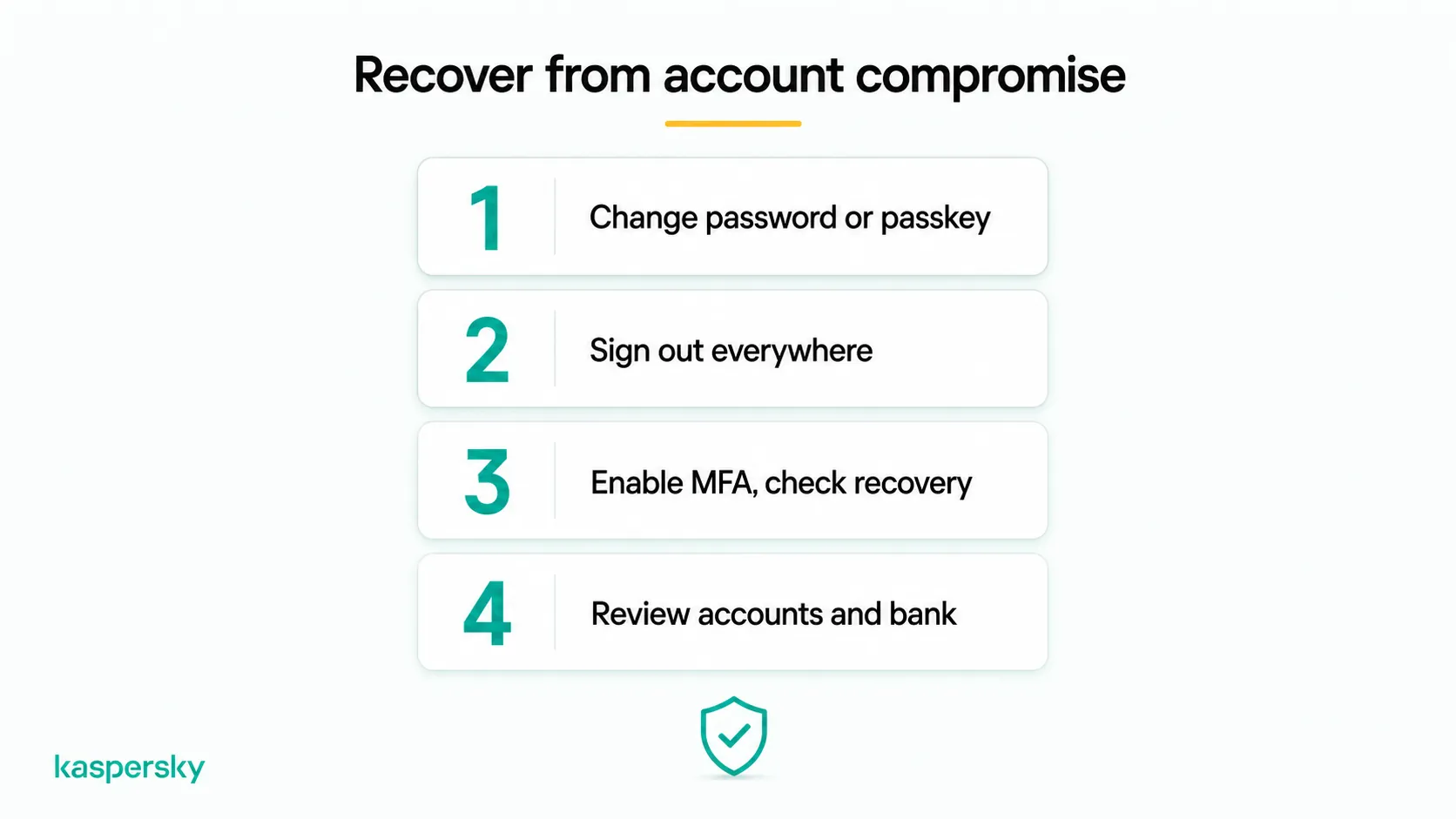
- Secure the affected account. Change your password immediately or switch to a passkey if the service supports it.
- Sign out of all active sessions and remove any unfamiliar devices connected to the account.
- Enable multi-factor authentication (MFA) and check that your recovery email address and phone number haven't been changed.
- Remove unknown connected apps or third-party integrations that could allow continued access.
- Check your other accounts for suspicious activity
- Change any reused passwords, starting with your primary email account, as it often controls access to other services.
- Review your bank accounts as a priority and all other workplace and online accounts for unfamiliar activity or unauthorized changes.
- Contact the relevant party if you believe sensitive information or financial accounts have been affected. This could mean contacting your bank’s anti-fraud team.
- Monitor for further login attempts and any signs of identity fraud. Act immediately if you notice additional suspicious activity.
Related Articles:
- What is identity theft and how does it impact you?
- What is cyber security and how does it protect our digital identities?
- What is a digital footprint and why does it matter?
- What are the best practices for IoT security?
Related Products:
- Kaspersky Premium Antivirus with Identity Theft Protection
- Download a free 30-day trial of our premium plan
- Kaspersky Mobile Security
FAQs
Can identity security prevent cyberattacks?
Identity security can't prevent every cyberattack, but it significantly reduces the risk of account compromise by verifying identities, limiting access, and detecting suspicious activity.
What is the principle of least privilege?
The principle of least privilege means giving users, devices, and applications only the minimum access they need to perform their tasks. It is designed to reduce the impact if an account is compromised.
Why is identity security important for cloud computing?
Cloud services rely on digital identities to control access. Identity security helps ensure only authorized users and systems can access cloud data and resources.
What are machine identities?
Machine identities are digital identities assigned to applications, devices, service accounts, bots, and AI agents, allowing them to securely authenticate and communicate with other systems.