
What is a pig butchering scam?
A pig butchering scam is a form of relationship-based investment fraud in which a scammer spends time building trust before encouraging the victim to invest money. The relationship may be a form of romance fraud. But the relationship can just be friendly or professional. It might even be focused on investment advice. The relationship can develop over weeks or even months.
Cryptocurrency is frequently used in these scams because it allows funds to be transferred quickly. People may have also heard of others making money out of cryptocurrency investments. But crypto itself does not define the scam. The core feature is the gradual manipulation of trust before financial pressure begins.
- Pig butchering scams rely on long-term trust-building rather than a single fraudulent message.
- The relationship may appear romantic, friendly, professional, or investment-focused.
- Victims are often introduced to a supposed investment opportunity only after trust has been established.
- Cryptocurrency is commonly involved, but the scam is fundamentally a form of confidence-based investment fraud.
- Fake investment websites, apps, or account balances may be used to make the opportunity appear legitimate.
- Urgency, requests for larger deposits, extra fees, or taxes before withdrawals are major warning signs.
Why is it called “pig butchering”?
The term comes from a metaphor used to describe the process of gradually building up a victim's trust before taking their money. The idea is that the victim is “fattened up” through attention and apparent investment success before the scammer attempts to extract as much money as possible.
The term refers to the scammer's method and should not be taken as a judgment on victims.
How do pig butchering scams work?
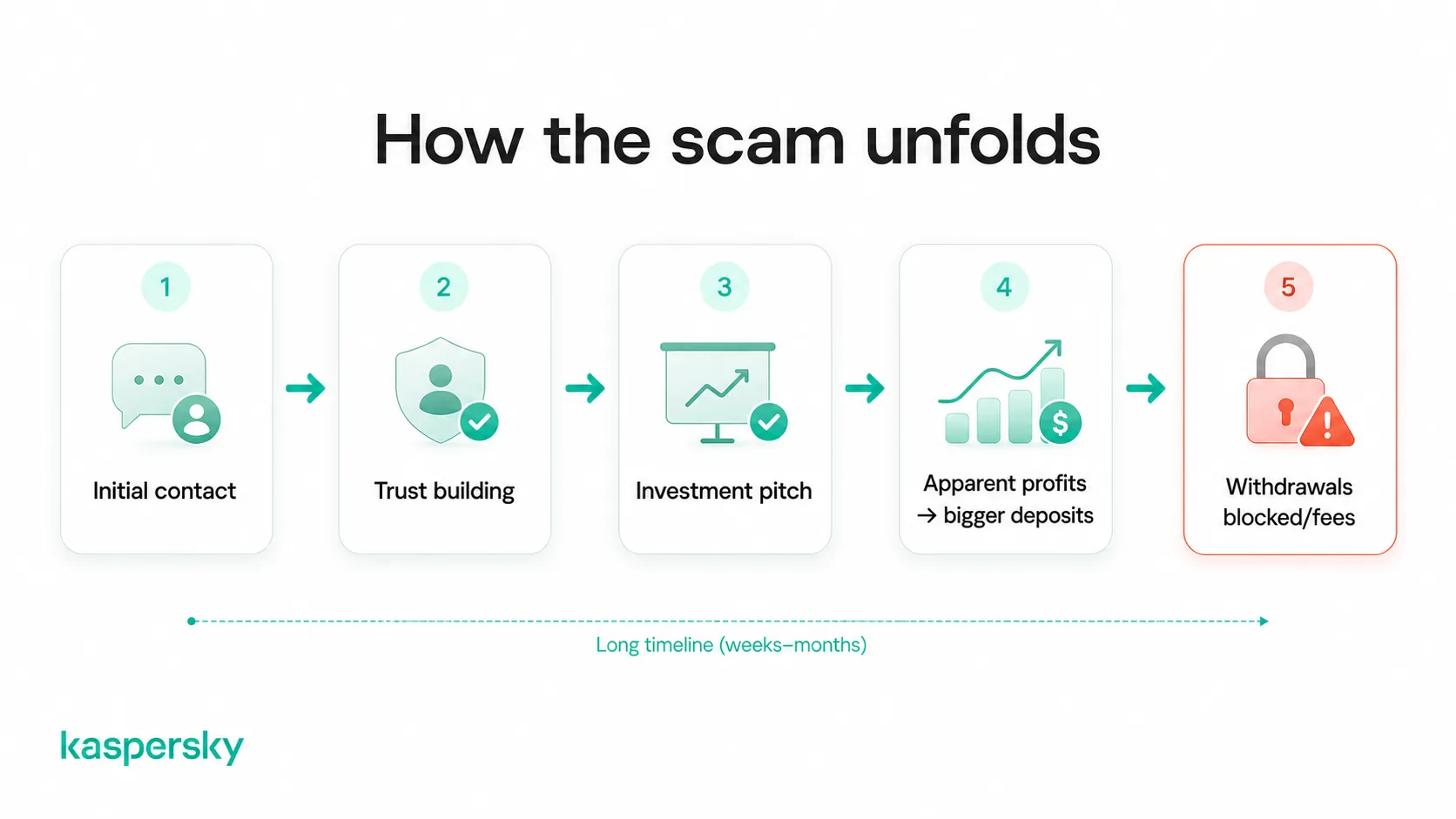
Pig butchering scams usually develop gradually. Scammers initiate contact, build trust, present an investment opportunity, provide fake profits to encourage bigger investments, and then block access to the funds or demand added fees.
A typical pattern looks like this:
- Initial contact. The scam begins through an unsolicited message, dating app, social media platform, LinkedIn, WhatsApp, Telegram, or an apparent wrong-number text.
- Trust building. The scammer spends time developing a relationship that may feel romantic, friendly, professional, or investment-focused.
- Investment opportunity. Once trust is established, the scammer introduces a supposedly profitable investment, often involving cryptocurrency.
- Apparent profits. The victim is shown convincing account balances or returns on a fake investment website or app.
- Larger deposits. Those apparent gains are used to encourage increasingly large investments.
- Blocked withdrawals: Access to funds may be denied or additional fees and taxes may be demanded.
This process can unfold over weeks or months. This gives the scammer a lot of time to build trust and make it appear legitimate.
What are real examples of pig butchering scams?
The FBI's Operation Level Up shows examples of how deeply victims can become convinced that a fraudulent investment is genuine.
One case showed that a victim was preparing to invest another $1 million when FBI agents contacted him. Another planned to sell her home to fund a $500,000 investment, while a third had already withdrawn $500,000 from a retirement account. The FBI says fake platforms may display false profits or even allow small early withdrawals to build confidence before encouraging much larger payments.
A separate FBI case involving a Kansas bank shows how dramatically these scams can escalate. The bank's CEO began by investing a few thousand dollars in what he believed was cryptocurrency. He then transferred more than $47 million from customer accounts to the scammers over the course of 12 months, eventually depleting the bank's holdings. The progression illustrates the core pattern of pig butchering fraud: a small initial commitment can spiral once the victim sees the supposed success.
How do scammers make fake investments look legitimate?
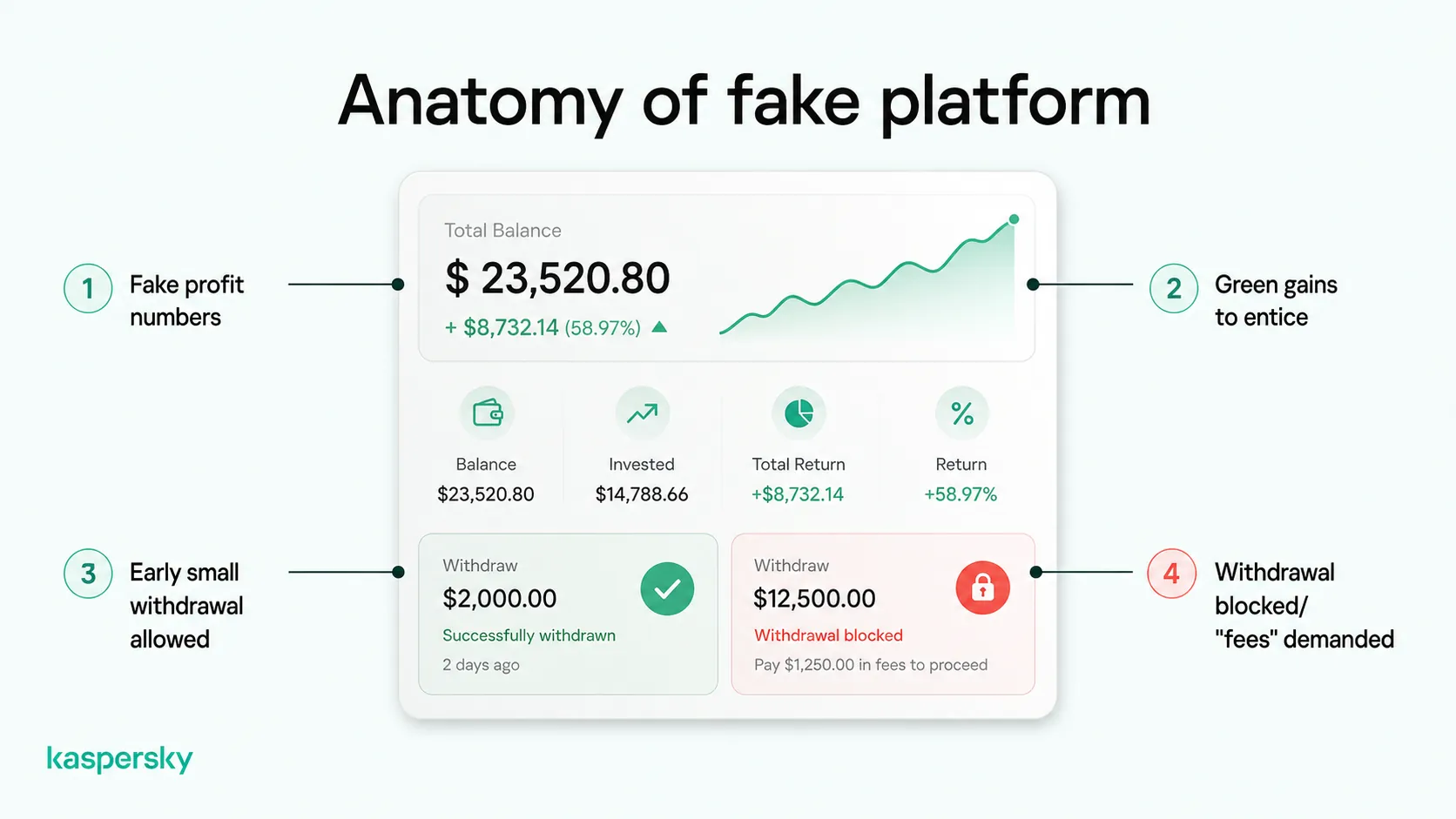
Scammers may create convincing investment websites or apps with trading dashboards that look very professional. They may have fabricated account balances showing apparent profits. Some even allow a small withdrawal early on. This can reassure the victim that the platform is genuine.
Once confidence has been established, the victim may be encouraged to deposit much larger amounts, often using cryptocurrency. When they later try to withdraw their money, the platform may block access or demand additional payments for supposed fees or account verification.
How can AI make pig butchering scams more convincing?
AI can strengthen the social-engineering side of pig butchering scams by helping create fake identities, realistic messages, synthetic photos, cloned voices, and deepfake video. This can make prolonged online relationships easier to maintain and harder to question.
Big butchering scams predate AI technology, so AI is not essential to these scams. However, it means that even realistic photographs, natural conversations, voice calls, or video interactions do not prove that someone is who they claim to be. All of these have become easier to fake through AI technology. Identities and investment opportunities should always be verified independently.
How widespread are pig butchering scams?
Pig butchering and related cryptocurrency investment scams have become a major source of reported fraud losses. The FBI’s 2025 Internet Crime Report reported that all forms of cryptocurrency investment fraud (including pig butchering scams) accounted for $7.2 billion in reported losses in the US during 2025.
The financial impact can grow far beyond an initial deposit. The FBI’s Operation Level Up has documented victims who were preparing to sell homes or take out large loans because they still believed the investment was genuine. As of December 2025, the FBI had contacted 8,103 victims, and 77% were unaware they were being scammed when contacted.
Reported figures are also unlikely to capture every case. Some victims may not report the fraud and others may not immediately realize that the investment platform or relationship is fake.
Who is behind pig butchering scams?
Pig butchering scams can be carried out by individual criminals, but many documented cases involve organized transnational criminal networks and large scam operations. Sophisticated operations may use teams of workers using scripted conversations, fake investment platforms, and money-laundering networks to manage scams at scale.
There is also a serious human trafficking dimension. The FBI has documented scam compounds where workers are themselves trafficking victims. There have been examples of people being forced to conduct online fraud. This means some people sending scam messages may also be victims of coercion and abuse.
What are the warning signs of a pig butchering scam?
Pig butchering scams often combine relationship-building with increasingly serious financial requests. Watch for these warning signs:
- Unsolicited contact through text, social media, dating apps, or messaging platforms.
- Rapid trust-building techniques including unusually personal or frequent conversations.
- Investment discussions that appear unexpectedly after the relationship develops.
- Guaranteed or unusually consistent returns with little or no apparent risk.
- Unfamiliar investment websites or apps that were recommended by the contact.
- Pressure to increase deposits. This may increase after showing apparent profits.
- Requests for secrecy or attempts to discourage you from speaking with family or financial professionals.
- Blocked withdrawals when you try to access your money.
- Demands for additional payments, such as supposed taxes, commissions, verification fees, or other charges before funds can be released.
No single sign proves that an investment is fraudulent. Several of these appearing together should be treated as a serious warning.
How can you protect yourself from pig butchering scams?
Slow the process down and verify everything independently when considering any communication from a stranger or somebody you don’t know that well. Be especially cautious if an online relationship unexpectedly turns toward investing or cryptocurrency.
Research any investment company, website, app, or individual using sources you find yourself rather than relying on links, screenshots, or explanations provided by the person contacting you. A convincing trading dashboard or even a successful small withdrawal does not prove that the investment is genuine.
Discuss any opportunity with someone independent whom you trust or a qualified financial professional. A legitimate investment should withstand outside scrutiny and should not depend on secrecy or pressure to act quickly.
Independently tested and awarded by the industry's leading labs.



What should you do if you have fallen for a pig butchering scam?
Act as quickly as possible if you believe you may have fallen for a scam:
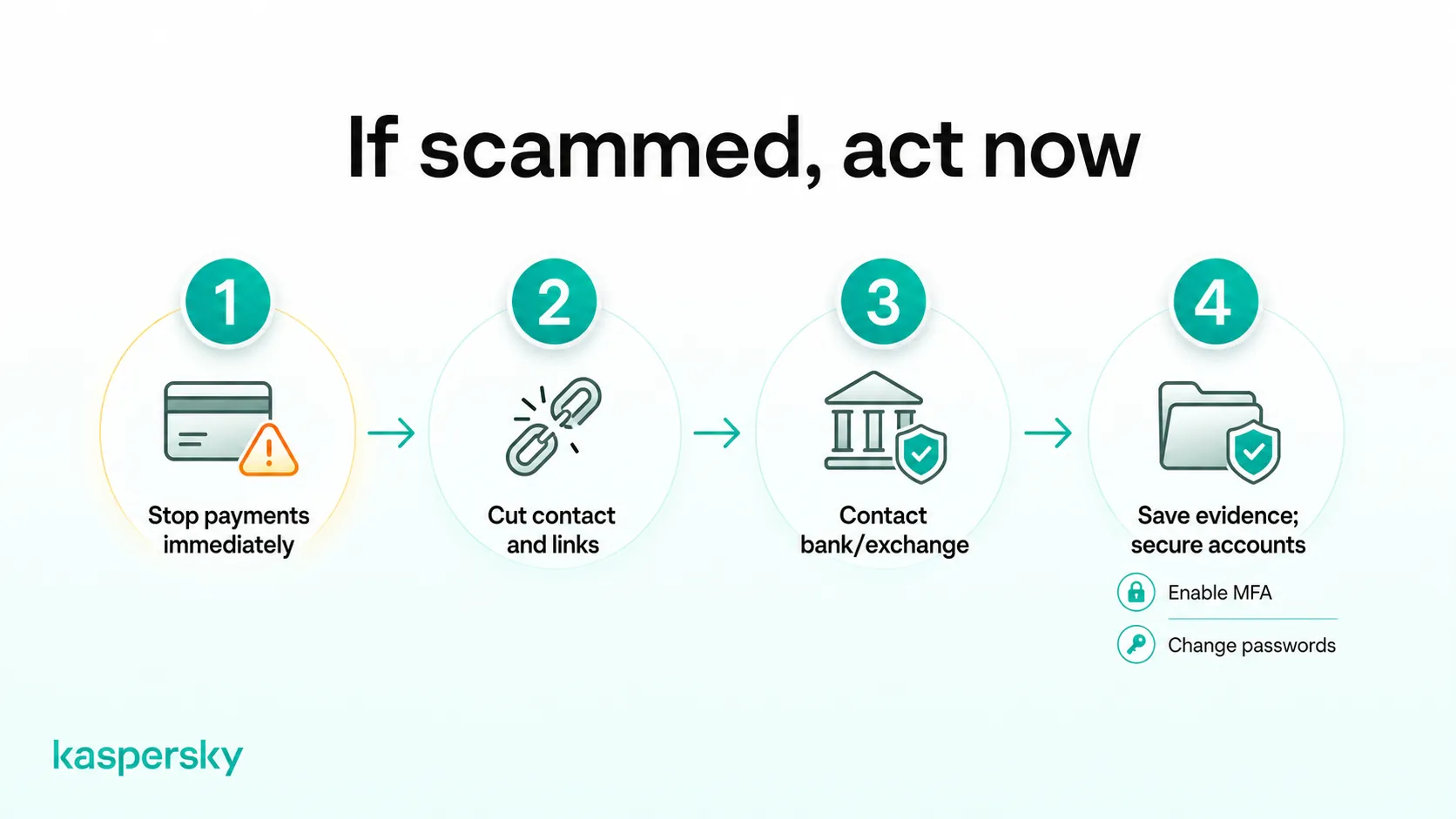
- Stop sending money and do not pay any additional fees or commissions.
- Stop communicating with the scammer and avoid further links or downloads they send.
- Contact your bank or cryptocurrency exchange immediately and explain what happened.
- Preserve evidence, including conversations, usernames, profiles, websites, transaction records, receipts, and cryptocurrency wallet addresses.
- Secure your accounts by changing compromised passwords. Enable multi-factor authentication and check for unfamiliar activity.
It is also important to report the scam through the appropriate national reporting channels where you live. In the US, this includes the FBI’s IC3 and the FTC.
Can you recover money lost in a pig butchering scam?
Sometimes. Recovery can be difficult, especially once cryptocurrency or other hard-to-reverse payments have been transferred. Contact the relevant bank or cryptocurrency exchange as quickly as possible. Early action may improve the chances of tracing or stopping funds.
Be wary of anyone who guarantees that they can recover the money.
What are pig butchering recovery scams?
Recovery scams target people who have already lost money by claiming they can retrieve the stolen funds. The scammer may pretend to be a lawyer, investigator, law-enforcement official, government representative, or cryptocurrency recovery specialist.
Common warning signs include:
- Upfront recovery fees.
- Requests for additional “taxes.”
- Guaranteed recovery.
- Requests for more cryptocurrency transfers.
These scams exploit the desire to recover the original loss and can cause further financial harm.
Related Articles:
- What are the dangers of Cryptocurrency scams in investment fraud?
- Learn more about Top scams how to avoid becoming a victim
- What is cryptocurrency and how does it relate to scams?
- How to avoid social engineering attacks effectively?
Related Products:
FAQs
Who is most vulnerable to pig butchering scams?
Anyone can be targeted. Risk increases when someone is isolated, actively seeking relationships or investment opportunities, or unfamiliar with cryptocurrency and online investment platforms.
How much money do people typically lose to pig butchering scams?
Losses vary widely. Some victims lose relatively small amounts, while others are persuaded to invest savings, retirement funds, borrowed money, or other substantial assets.
Can pig butchering scams involve romance scams?
Yes. Some begin as romantic relationships and even start on dating sites. Others appear friendly, professional, or investment-focused. The defining feature is prolonged trust-building followed by financial manipulation.
Can pig butchering scammers steal personal information as well as money?
Yes. Scammers may collect personal details or identification documents during the relationship. This creates additional risks such as identity theft.