
Spyware is designed to infiltrate a device and collect your information in the background while remaining difficult to detect. It can steal passwords, capture personal data, and even access sensitive information without the user's knowledge.
What you need to know:
- Spyware is a form of malware that secretly monitors activity and steals information from computers, phones, and other connected devices.
- It often spreads through malicious apps, phishing emails, fake downloads, or software bundles.
- Common targets include passwords, banking details, browsing history, messages, and personal data.
- Slow performance, unusual pop-ups, battery drain, and unfamiliar apps can all be signs of spyware.
- Keeping software updated, reviewing app permissions, enabling multi-factor authentication, and using trusted security software can significantly reduce the risk of infection.
What is spyware?
Spyware is malicious software designed to enter a device and gather information about the user. It may then send that data to a third party without their consent. Malicious spyware is specifically designed to profit from stolen data or unauthorized surveillance.
The term spyware can also refer to legitimate software that tracks user behavior for commercial purposes. This includes things like advertising or analytics.
Spyware’s surveillance activity leaves you open to data breaches and misuse of your private data. Spyware also affects network and device performance and can slow down daily user activities.
Understanding what spyware is and how it works is the first step toward recognizing the risks and protecting your personal information.
Is spyware a type of malware?
Yes. Spyware is a type of malware designed to secretly monitor activity and collect information from an infected device. Spyware is often confused with other forms of malware but each has a different purpose. Spyware focuses on gathering data. This could be passwords or financial information. It collects the details without the user's knowledge.
Viruses are designed to replicate by attaching themselves to other files and spreading across systems, while Trojans disguise themselves as legitimate software to trick users into installing them. A Trojan may even be used to deliver spyware onto a device.
Different threats can work together. A phishing email might install a Trojan which then deploys spyware to monitor activity and steal sensitive information.
What does spyware do?
Spyware secretly monitors activity on a device and collects information that can be used by attackers or sold to third parties. It can observe what users do online and transmit sensitive information without their knowledge.
The consequences go beyond privacy. Stolen information can be used for identity theft, account takeovers, financial fraud, or targeted phishing attacks. Some spyware also consumes system resources and slows devices.
Because spyware is designed to remain hidden, it can continue collecting information for long periods before it is detected, increasing the amount of personal data exposed.
What information can spyware steal?
The information collected depends on the type of spyware.
Common targets include:
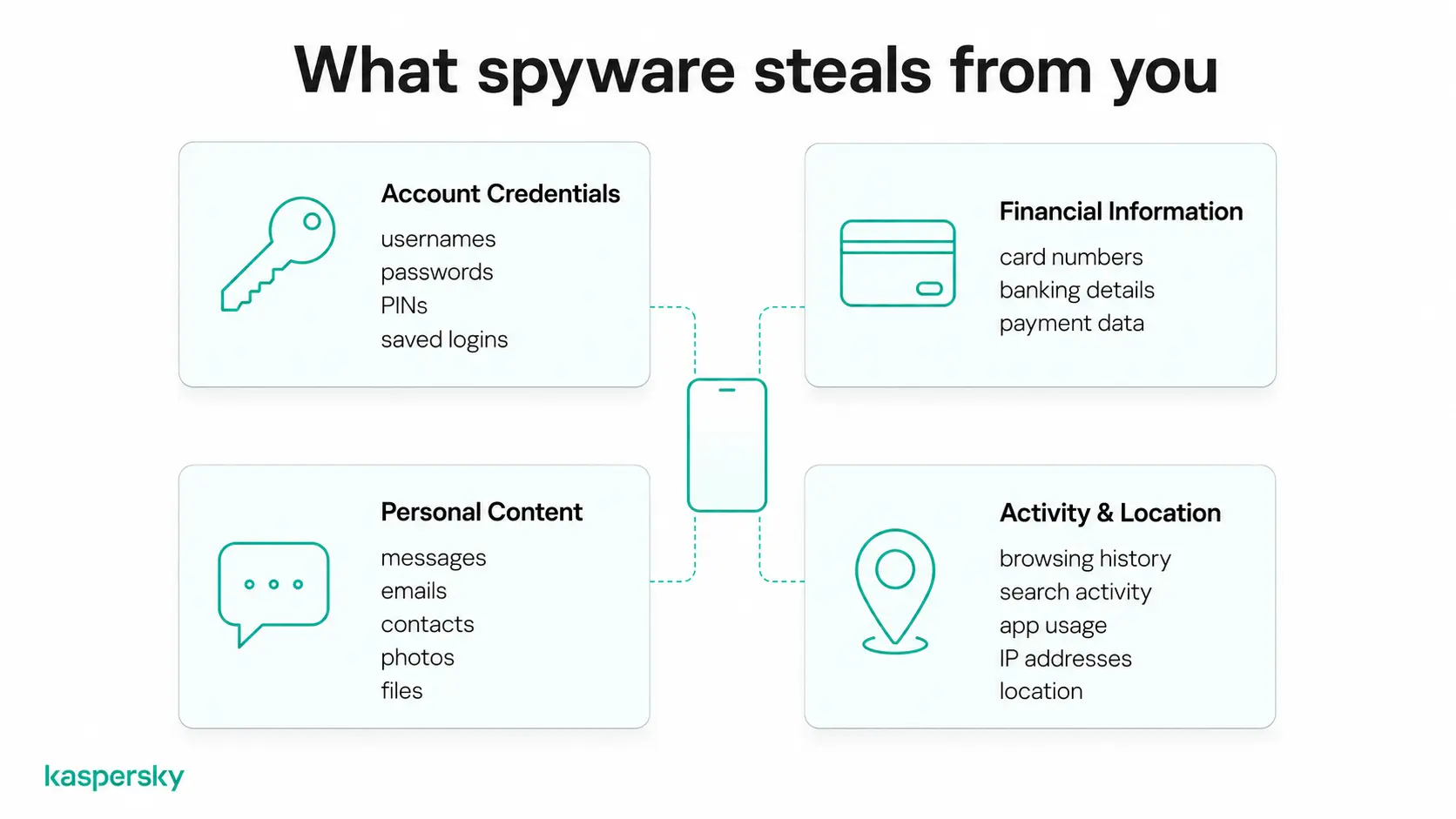
- Account credentials: usernames, passwords, PINs, and saved login details that can be used to access online accounts.
- Financial information: payment card numbers, online banking details, and other information that could be used for fraud.
- Personal content: messages, emails, contact lists, photos, and files stored on the device.
- Activity and location data: browsing history, search activity, app usage, IP addresses, and location information that can be used to build detailed user profiles or support more convincing scams.
What types of spyware exist?
Each form of spyware is designed to collect different types of information or monitor different aspects of a device.
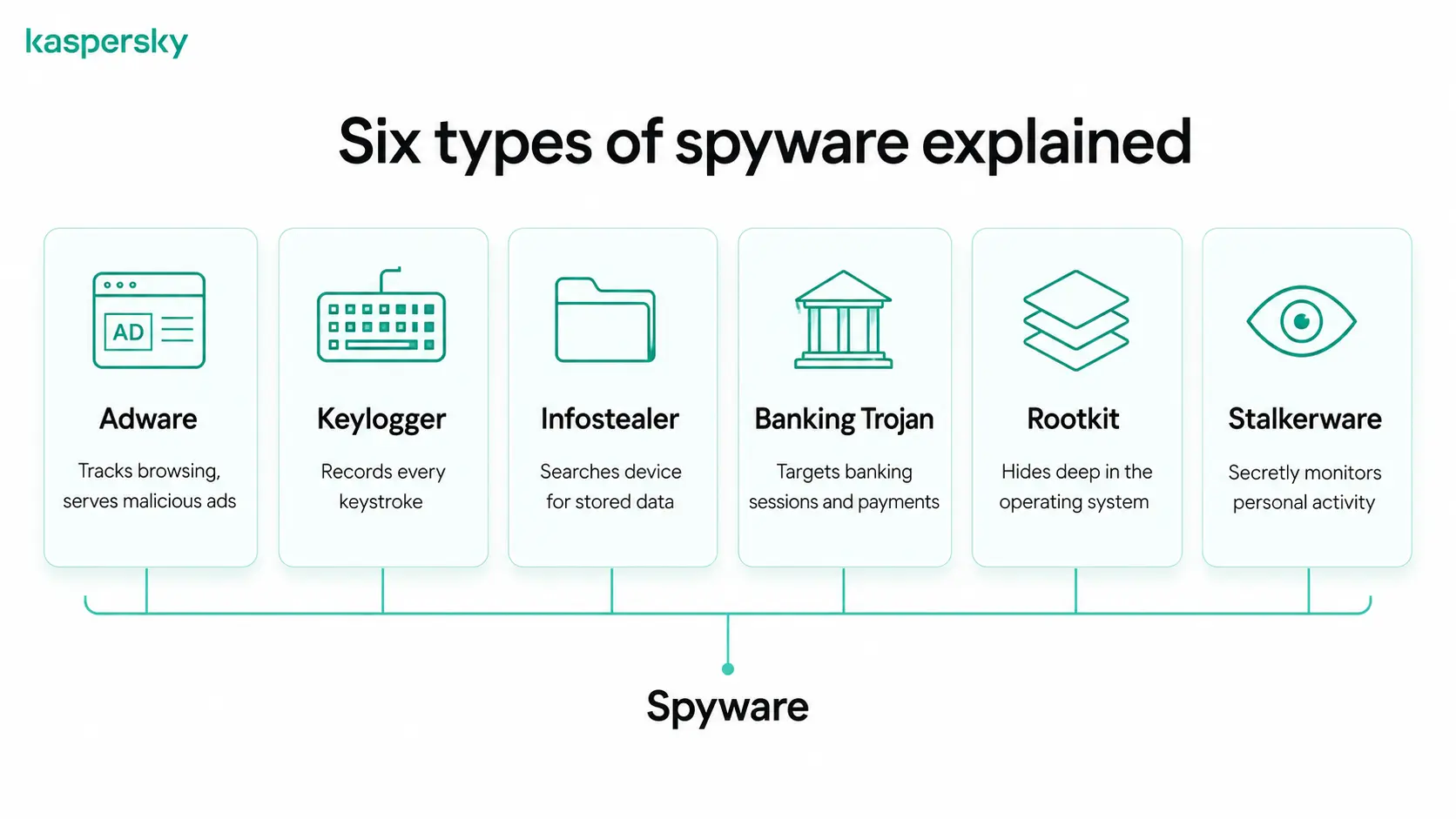
- Adware may monitor you to sell data to advertisers or serve deceptive malicious ads.
- Keyloggers and infostealers track any activity on a computer, capturing sensitive data such as keystrokes, sites visited, emails, and more.
- Trojan spyware enters devices via Trojan malware, which delivers the spyware program.
- Stalkerware is usually installed by an individual to spy on activities and steal data and private information.
- Browser hijackers can track or even take over browsers, stealing data but also injecting ads or sending users to malicious sites.
Adware, keyloggers, and infostealers
Adware may monitor you to sell data to advertisers or serve deceptive malicious ads. Ads are common online but malicious adware can collect data without permission and expose users to unsafe content.
Keyloggers record everything typed on a keyboard. This means attackers can capture important details like passwords and messages as they are entered.
Infostealers are designed to search devices for valuable information. This might include:
- Saved browser passwords
- Cookies
- Cryptocurrency wallet details
- Autofill data
- Login sessions
They have become one of the most common forms of modern spyware because they can quickly gather large amounts of sensitive information.
Banking Trojans and rootkits
Banking Trojans disguise themselves as legitimate software while targeting online banking sessions and payment information. They can steal login credentials or even one-time authentication codes to facilitate financial fraud.
Rootkits operate at a deeper level within the operating system. They allow spyware or other malicious software to hide its presence and avoid detection. Rootkits are often more difficult to identify and remove than other spyware threats because they can conceal their activities.
Stalkerware and browser hijackers
Stalkerware is designed to secretly monitor another person's device and steal private and personal information. It is often installed by someone with physical access to the device and raises serious privacy and safety concerns.
Browser hijackers change browser settings without permission. This means they can redirect searches or display unwanted advertisements on devices. They can track browsing activity and expose users to malicious websites or fraudulent content.
Who is targeted by spyware?
Spyware can affect anyone who uses a computer or internet-connected device. Some high-profile cases involving journalists or politicians often make headlines. The vast majority of spyware infections target ordinary users.
Many attacks are opportunistic rather than personal. Cybercriminals distribute spyware through malicious apps or scattergun phishing campaigns knowing that even a small percentage of successful infections can provide valuable information.
Businesses are also frequent targets because employee devices may provide access to huge amounts of customer records or confidential information. Consumers remain attractive targets for identity theft.
Watch this video to find out signs of spyware on your phone as well as learn how to remove it:
How does spyware get onto your device?
Spyware rarely appears on a device by itself. It usually relies on users installing a malicious file or granting permissions to software that appears legitimate.
Many infections begin with everyday activities such as downloading an app or visiting a compromised website. Spyware is often disguised as legitimate software to operate unnoticed from the moment it is installed.
Some bundled spyware installs discreetly without warning. Other times, your desired software will describe and require the spyware in the license agreement (without using that term). By forcing you to agree to the full software bundle to install the desired program, you are voluntarily and unknowingly infecting yourself.
Phishing attacks and malicious downloads
Phishing remains one of the most common ways spyware spreads. Attackers use messages or websites that appear to come from trusted companies and encourage users to take action. This is usually in the form of clicking a link or downloading a file.
Spyware can also be hidden inside pirated software, unofficial mobile apps, fake software updates, or free utilities downloaded from untrusted sources. The spyware is often delivered by a Trojan. Trojans are named this because they appear harmless while secretly installing malicious code in the background.
Downloading software only from official publishers and verifying unexpected messages can significantly reduce the risk of infection.
Browser extensions and zero-click attacks
Not all spyware arrives through downloaded programs. Malicious browser extensions may request broad permissions that allow them to monitor browsing activity or collect personal information.
Many people install browser extensions for everyday tasks such as finding coupons and comparing prices. There are also extensions for things like AI assistants and grammar checkers. These tools are not inherently risky, but they often request permission to read and change data on the websites you visit. If an extension is malicious or later becomes compromised through an update or developer account breach, those broad permissions could be abused.
More advanced spyware can exploit previously unknown software vulnerabilities, sometimes requiring little or no interaction from the user. These so-called zero-click attacks are uncommon and are usually associated with highly targeted campaigns.
What are the signs of spyware infection?
Spyware is designed to remain hidden. Some infections produce few or no obvious symptoms. However, changes in device performance or unusual account activity can indicate that something is wrong.
One symptom on its own is not proof of spyware, but several occurring together are worth investigating.
Warning signs on computers
Common signs of spyware on a computer include:
- Slower performance or applications taking longer to open
- Unexpected pop-ups, advertisements, or browser redirects
- Unexplained changes to the homepage or default search engine
- Unknown programs or browser extensions appearing without permission
- Frequent crashes or performance problems, or unusually high CPU or memory usage
These symptoms can also be caused by other software issues, but persistent or unexplained behavior should not be ignored.
Warning signs on phones
Spyware on devices often appears as unusual background activity rather than obvious pop-ups.
Watch for:
- Rapid battery drain or the device becoming unusually hot
- Increased mobile data usage without a clear explanation
- Apps requesting permissions they do not appear to need
- Slow performance, random restarts, or apps opening unexpectedly
- Strange text messages, notifications, or unfamiliar apps appearing on the device
Reviewing installed apps and running a trusted security scan is a sensible next step if you see multiple symptoms or warning signs.
How do you detect spyware?
Spyware is designed to avoid detection. This means that confirming an infection often requires more than noticing unusual behavior. The best approach is to combine manual checks with trusted security software that can identify known threats and suspicious activity.
Start by reviewing recently installed applications and account permissions. If you notice software you do not recognize or settings you did not change, investigate before continuing to use the device. Running a full security scan with Kaspersky’s security software is one of the most reliable ways to detect spyware and other malicious programs.
Protect your device from spyware
Kaspersky Premium offers various tools designed to protect your devices, including multilayered protection designed to prevent and neutralise viruses and malware such as spyware.
Try Premium for FreeHow do you detect spyware on Android?
Begin by reviewing the apps installed on your device and removing anything unfamiliar or no longer needed. Check the permissions granted to each app, paying particular attention to access for the camera, microphone, location, contacts, accessibility services, and device administration.
You should also review battery and data usage to identify apps that are unusually active in the background.
Run a scan using trusted mobile security software. Security tools can detect known spyware for Android devices.
How do you detect spyware on an iPhone?
Detecting spyware on an iPhone can be slightly more challenging because iOS limits how apps interact with the operating system. Users can still perform several useful checks.
Review Settings for unfamiliar apps with extensive permissions. Check Privacy & Security to see which apps can access sensitive features. Does the app really need access to the microphone or camera?
Always inspect VPN & Device Management for configuration profiles or management profiles that you did not install.
Monitoring battery usage and mobile data consumption may also reveal apps running unexpectedly in the background. No single symptom confirms an infection. A combination of unusual settings or activity provides the clearest indication that further investigation may be needed.
How do you remove spyware?
Most spyware infections can be removed. The key is to stop further access, scan the device, remove suspicious software, and then secure any accounts that may have been exposed.
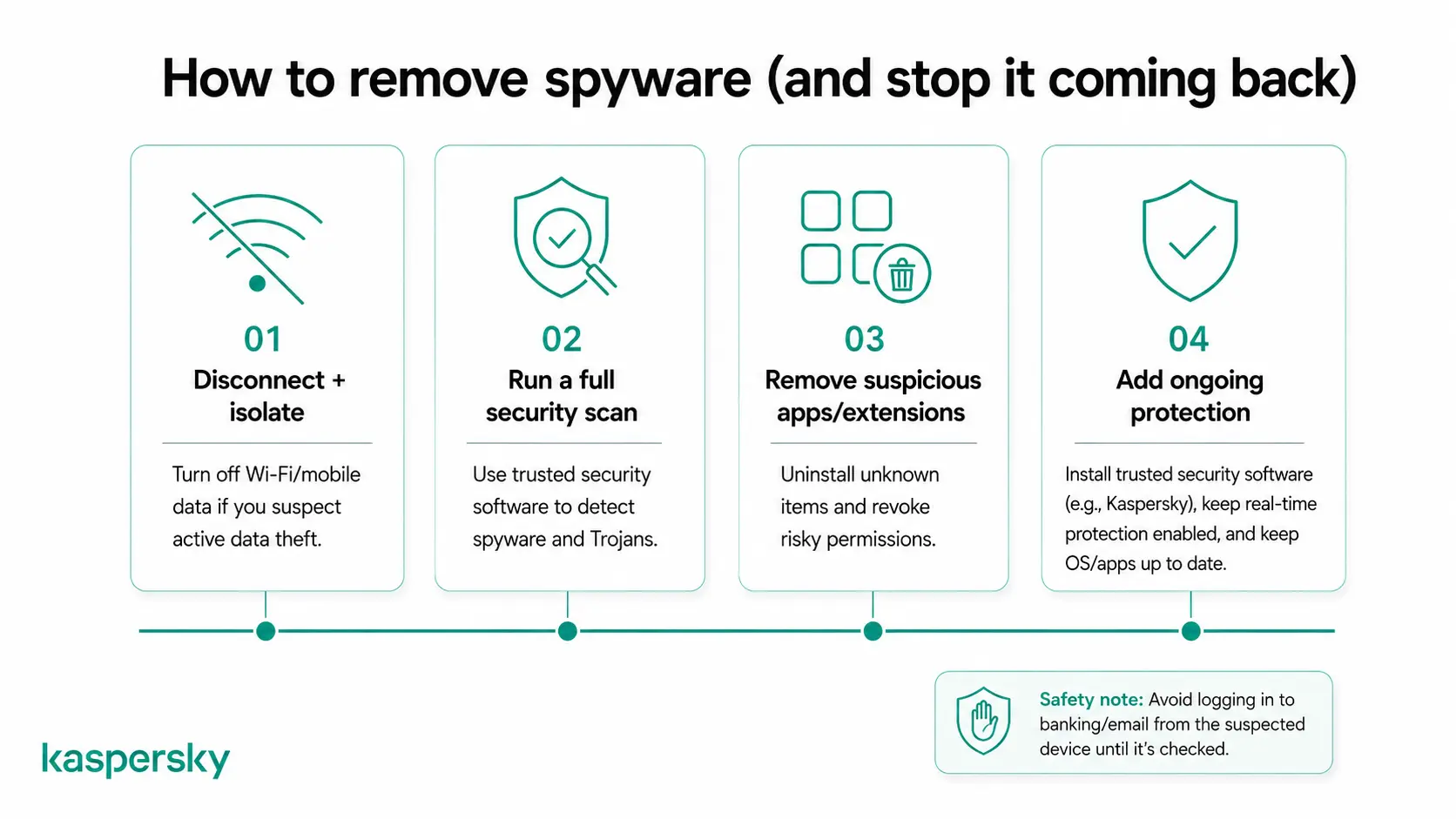
Start with the device you believe is affected. Avoid logging into sensitive accounts from that device until it has been checked. Spyware may still be able to capture passwords or activity until it is fully removed.
If you suspect spyware
Follow these steps in order if you suspect spyware has infiltrated your device:
- Disconnect sensitive accounts. Avoid using banking, email, cloud storage, or work accounts on the affected device until it has been checked. If possible, sign out of important accounts from another trusted device.
- Run a security scan. Use trusted antivirus or mobile security software to scan for spyware, Trojans, malicious apps, and suspicious system changes.
- Remove suspicious apps and extensions. Uninstall unfamiliar apps, recently downloaded programs, and browser extensions you do not recognize. Also remove any software that requests permissions it does not clearly need.
- Update the device. Install operating system and app updates, as these often close security gaps used by spyware.
- Change important passwords from a clean device. Prioritize email, banking, social media, cloud storage, and any accounts that were used on the infected device.
- Enable multi-factor authentication. MFA helps protect accounts even if spyware captures a password before removal.
If the infection persists
Some spyware is designed to survive basic removal attempts or may have already compromised account credentials before it is detected.
First, change passwords for important accounts from a clean, trusted device rather than the potentially infected one. Prioritize email accounts, as these are often used to reset passwords for other services. Enable multi-factor authentication wherever possible.
If the device continues to show signs of infection, consider performing a factory reset (mobile devices) or a complete operating system reinstall (computers). This removes installed applications and settings. It will also get rid of most forms of spyware, but it should only be done after backing up important files.
When restoring the device, reinstall only trusted applications from official sources.
How can you prevent spyware?
Safe online habits with basic security protections can significantly reduce the risk of infection. Most spyware relies on users downloading something or granting access they did not intend to give. Users can block many common infection routes before they become a problem by tightening their security.
Protecting your accounts and devices
Keeping devices and accounts secure helps reduce the opportunities spyware can exploit.
Install operating system and app updates as soon as they become available. Updates often contain security patches for newly discovered vulnerabilities. Enable multi-factor authentication (MFA) on important accounts to add protection if login credentials are stolen.
Always stick to official app stores and trusted app publishers. Official sources generally apply security checks that reduce the likelihood of downloading malicious software.
Avoiding common mistakes
Many spyware infections begin with a simple mistake, such as clicking a link or installing software from an untrusted source.
- Be cautious with links and attachments in emails, text messages, social media messages, and unexpected pop-ups. Even messages that appear to come from trusted organizations can be part of a phishing attempt.
- Avoid pirated software and "cracked" applications. These are common delivery methods for spyware and other malware.
- Keep all software updated with the latest security. Malware can get installed onto your system through operating systems and app vulnerabilities. Updates commonly include security patches to fix these natural weaknesses.
How is spyware different from other types of malware?
As mentiones, spyware is only one type of malware. While all malware is designed to compromise a device or its data, different threats have different objectives and behaviors.
Understanding these differences makes it easier to recognize the risks and choose the right response if a device is compromised.
Spyware vs. viruses, Trojans, and ransomware
Threat Primary purpose Typical behavior
Spyware Secretly collect information Monitors activity, steals passwords, browsing data, messages, or financial information
Virus Replicate and spread Attaches itself to files and copies itself to infect other files or systems
Trojan Trick users into installing malware Disguises itself as legitimate software and often delivers spyware or other malicious programs
Ransomware Extort money Encrypts files or locks devices and demands payment for restoration
These threats are not mutually exclusive and may work together to steal your data.
What is Pegasus spyware?
Pegasus is one of the most sophisticated spyware families ever discovered. Pegasus has been linked to advanced attacks that can compromise smartphones using previously unknown software vulnerabilities.
Some versions have used zero-click attacks that allow infection without the user opening a link or installing an app. Pegasus is capable of accessing messages, photos, calls, microphones, cameras, and location data while attempting to remain hidden.
Pegasus has primarily been associated with highly targeted campaigns against high-profile individuals. It is not representative of the spyware most people encounter through phishing attacks.
Pegasus demonstrates how powerful modern spyware can become and highlights the importance of keeping devices updated and using trusted security protections.
Related Articles:
- What are the different types of spyware you should know about?
- How can I detect spyware on Android devices?
- What are the best strategies for effective malware protection?
- What is malware and how can you remove it?
Related Products:
FAQs
Can spyware access your camera and microphone?
Some spyware can access a device's camera and microphone if it has been granted the necessary permissions or exploits a security vulnerability. More advanced spyware may also capture videos or audio recordings without the user's knowledge.
Can antivirus software detect spyware?
Yes. Modern antivirus and anti-spyware software can detect and remove many known spyware families by scanning for malicious files and unauthorized system changes. Kaspersky Premium prevents viruses and malware, including spyware, from being installed on your device.
Can spyware steal passwords?
Yes. Many types of spyware are designed to steal passwords, login credentials, and other sensitive information. Keyloggers record what users type, while infostealers can extract saved passwords and autofill data.
Can spyware survive a factory reset?
In most cases, a factory reset removes spyware by deleting installed apps and restoring the device to its default state. If an infected backup is restored or compromised software is reinstalled, the infection can return. Always restore only trusted apps and data.