Kaspersky’s latest survey highlights a protection gap between macOS and Windows based devices. While macOS has long been regarded as the more secure operating system, 12% of its users reported malware infections compared with 9% of Windows users. Moreover, only 35% of macOS owners install dedicated security software, versus 42% of Windows users.
According to Kaspersky’s latest survey*, Windows users report a higher adoption rate for most security measures, while macOS users show a modest advantage in a few privacy‑focused actions. At the same time, during the past year macOS users reported higher percentages than Windows users for a number of cybersecurity incidents.
The largest gap in cybersecurity approaches appears in the habit of not opening suspicious emails or links, with 62% of Windows users following this practice compared to 51% of macOS users. What’s more, when it comes to cybersecurity software installation, macOS users are also lagging behind. While among Windows users 42% reported using digital‑life‑protection software, for macOS this rate is only 35%, what Kaspersky security experts call a worryingly low figure.
It is noteworthy that 12% of macOS respondents said they fell victim to phishing (fake emails, websites or messages) over the past year compared with 9% of Windows users. Moreover, during this period macOS users faced more scams and investment frauds (16% vs 13%), privacy violations (11% vs 8%) and thefts of personal data (12% vs 7%).
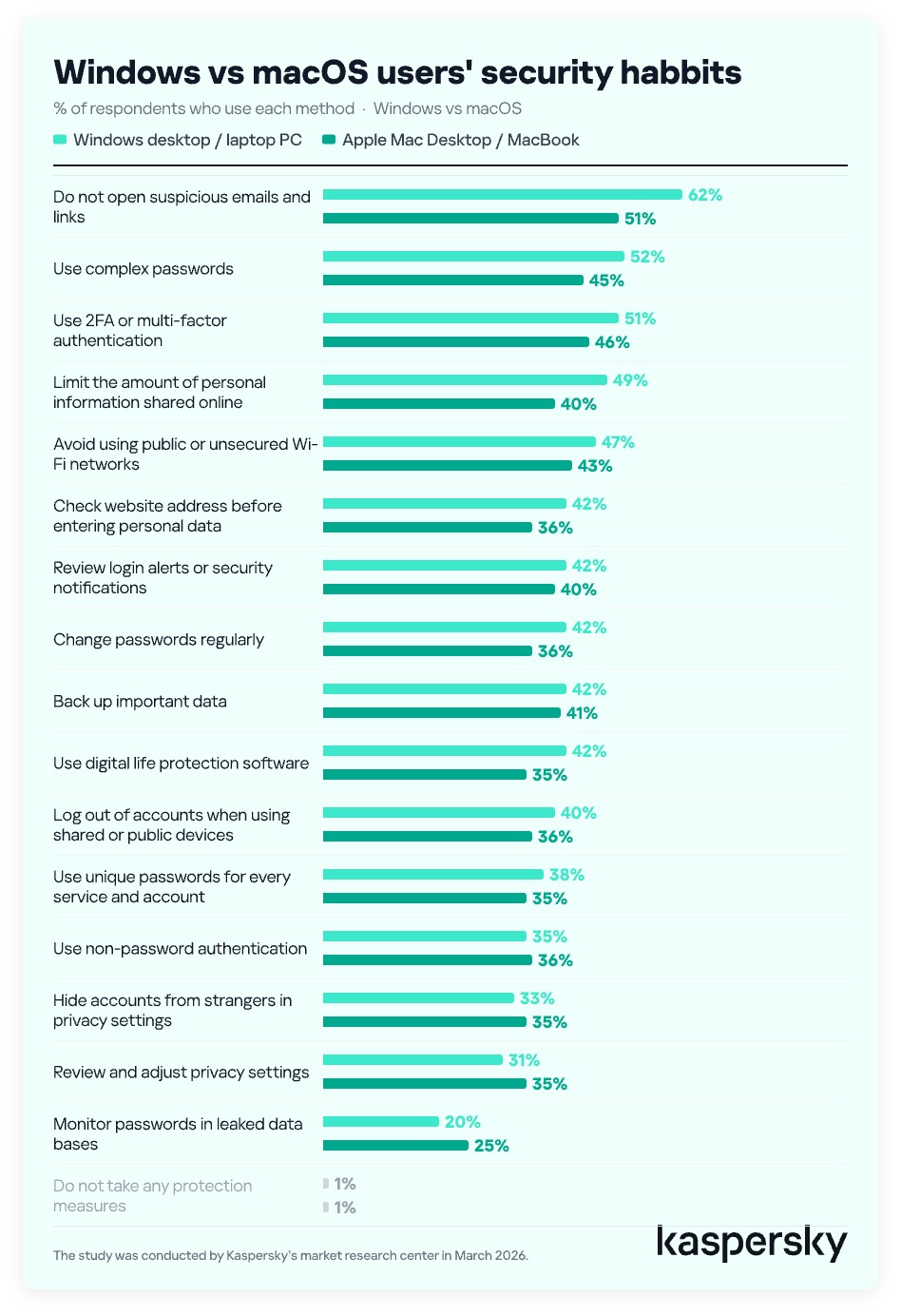
Infographics: Windows vs macOS users’ security habits
To counter these specific threats, robust anti-malware and anti-phishing protection is essential. Malware authors put a lot of effort into developing new, more powerful and stealthier versions of stealers, spies and other classes of malicious payloads, while relying on phishing techniques that allows them to get access to user’s data.
Dedicated security solutions add a crucial layer of real-time detection and defense that complements macOS's built-in protection - and independent tests have repeatedly shown that effective options, such as Kaspersky Premium for macOS, deliver strong protection. In 2025, AV-TEST recognized it as the top-performing macOS security solution based on consistent, reliable results across a full year of evaluations.
When it comes to credentials and passwords safety, Windows users also shows better security practices’ adoption rates. They lead in using a unique password for each account (38 % vs 35 %) and complex passwords (52 % vs 45 %), two‑factor or multi‑factor authentication (51 % vs 46 %).
Adopting a dedicated password manager becomes a logical next step. Such tools store all credentials in a secure vault protected by a single master password, eliminating the need to remember hundreds of passwords while keeping them safe from breaches. They also support modern authentication methods like passkeys, enabling seamless, single-tap sign-in across all devices through secure synchronization – capabilities offered by solutions such as Kaspersky Password Manager.
“There are entrenched stereotypes that macOS is inherently more secure because its user base is smaller, leading cyber‑criminals to deem it a lower‑value target, or because the platform itself includes many robust security features. While these observations are not entirely unfounded, the threat landscape has evolved dramatically. Attackers actively employ phishing and commit supply‑chain attacks, which often allow them to affect users of any operating system in a single malware campaign. Moreover, mac‑specific malware is not rare and there are many malware families that target Macs exclusively. Consequently, any device with an internet connection, regardless of its operating system or form factor, requires cybersecurity software to defend against a wide range of cyber threats,” comments Sergey Puzan, cybersecurity expert at Kaspersky.
*The study was conducted by Kaspersky’s market research center in March 2026. 7200 respondents from 18 countries (Brazil, China, Colombia, Egypt, France, Germany, India, Indonesia, Italy, Malaysia, Mexico, Russia, Saudi Arabia, Spain, South Africa, Thailand, Turkey, Vietnam) took part in the survey.


