 privacy

Tech giants are taking another shot at smart glasses. The idea has long captivated the minds of sci-fi writers and their biggest fans — the denizens of Silicon Valley. Many will remember Google Glass, the first real attempt at creating such a device back in 2012. It went down as one of Google’s few major flops.
Following Google’s glaring failure, other tech giants such as Meta, Apple, and Microsoft temporarily shelved the idea of sleek, lightweight glasses in favor of bulkier VR headsets. One of the main reasons for the shift was that the tech back in the 2010s simply wasn’t advanced enough to pack high-end features and decent battery life into a compact pair of glasses.
Since then, however, much has changed. Now, tech giants are doing a 180 and pivoting back to smart glasses for everyday use. For instance, just this past June, Snap (the company behind Snapchat) dropped a new version of its glasses called SPECS. Rumor has it that Apple might unveil its own take on the tech later this year.
For now, though, the collaboration between Ray-Ban and Meta is the undisputed king of the market. They launched their most advanced smart glasses in 2025, selling over 7 million pairs that year alone.
However, Ray-Ban Meta glasses have been plagued by a string of ugly controversies since early 2026. They all center around a feature that would allow the glasses’ camera to recognize faces within its field of view. When activated, the feature would notify the user whenever the system identified someone.
What exactly are Ray-Ban Meta glasses?
Ray-Ban and Meta first teamed up in 2020. At the time, these sleek, high-tech glasses were envisioned as a tie-in for the Metaverse — tech guru Mark Zuckerberg’s massive VR project. As it turned out, the glasses outlived the project they were built for. But let’s not rub salt in Zuckerberg’s wounds. In 2021, Ray-Ban and Meta dropped their first collab: the Ray-Ban Stories glasses. Two years later, the next generation hit the shelves, rebranded simply as Ray-Ban Meta. Then, in 2025, Zuckerberg himself unveiled the AI-powered Ray-Ban Meta Gen 2 glasses. That’s the version we’re looking at today.
Unlike the original Ray-Ban Meta glasses, Gen 2 is pitched as a gadget for workouts and everyday life. Initially, the companies offered two frame models — Wayfarer and Headliner — both available in a variety of colors. The lenses come in different tint levels: standard clear, dark sunglasses, or photochromic. Prescription lenses are also available for an extra fee.
Meta later rolled out a few more frame options, including the Oakley Meta HSTN and the Oakley Meta Vanguard (Oakley being another eyewear brand owned by the same parent company as Ray-Ban, EssilorLuxottica). Regardless of the frame model, all these devices pack the same core features:
- Capturing POV photos and videos
- Playing music, podcasts, and other audio content
- Making phone calls
- Sending and receiving messages using voice commands
- Translating speech in real time with support for multiple languages
- Converting speech to text
- Reading out notifications and messages
- Creating voice notes and reminders
- Broadcasting first-person video for WhatsApp and Messenger video calls
- Navigating the map through spoken prompts
- Answering user questions about surroundings and objects in view
Meta smart glasses operate using several built-in components. First, the glasses are equipped with a camera for taking photos and recording videos directly from your eye line. Second, the temples house open-ear speakers. These let you listen to music, get directions, take calls, and hear Meta AI’s responses without blocking out the world with earbuds — a questionable perk if you value audio privacy.
Finally, the glasses have several built-in microphones used for phone calls, voice command recognition, and interacting with the AI assistant. What most Meta smart glasses lack, though, is a screen. Only the priciest, top-tier model — the Meta Ray-Ban Display — actually features a built-in display.
Every photo and video captured by the glasses’ camera, along with the device settings, is stored in the Meta AI companion app, which syncs the glasses with a smartphone. It’s this combination of camera, mics, speakers, and the Meta AI app that allows the device to analyze its surroundings and respond to user queries in real time.
Compared to something like the Apple Vision Pro, Meta’s gadgets are relatively inexpensive, hovering around the $400 to $500 mark. What’s more, Meta just dropped a brand-new line under its own name, Meta Glasses, starting at an even lower $299. With price tags like that, the idea of these things going mainstream isn’t sci-fi anymore.
That makes the reports about the NameTag feature all the more alarming. According to journalists and researchers, this feature is designed to recognize people who enter the glasses’ field of view. Let’s dig into the details.
NameTag: the feature that ‘doesn’t exist’
Information leaked from internal Meta documents regarding the development of a facial recognition feature for the company’s smart glasses emerged, by eerie coincidence, on Friday, February 13, 2026. The leaked data reveals that the feature, internally dubbed NameTag, would use Meta’s built-in AI assistant to identify people caught within the glasses’ camera view and provide the device owner with information about them.
According to the leak, Meta considered two ways to run NameTag. The first version would only recognize people from the user’s existing contacts across Meta’s services. The second version would be much broader and could identify anyone with a public profile on the company’s social media platforms: Instagram, Facebook, and potentially WhatsApp and Messenger.
If that gives you the creeps, fear not. The tech giant, famously known for its “oh so totally ironclad” commitment to user privacy, was quick to issue a reassuring statement:
“Our competitors offer this type of face-recognition product; we do not. If we were to release such a feature, we would take a very thoughtful approach before rolling anything out.”
Proof of this thoughtful approach emerged just a few months later. In June 2026, Wired reported that Meta had quietly embedded facial recognition tech for its smart glasses into the Meta AI app. According to journalists, the code had been slipped into the software bit by bit over several months, starting in January 2026.
How the supposedly nonexistent feature works
At the time the investigative report was published, NameTag wasn’t available to users. However, according to Wired, the code required to run it was already present in the Meta AI companion app, which is used by owners of the company’s smart glasses and installed on over 50 million smartphones.
NameTag relies on three AI models to do its thing.
- The first model detects faces within the camera’s field of view.
- The second isolates and crops those facial images.
- The third converts those images into unique biometric prints.
According to Wired, all three models had already been pulled from Meta’s servers and were sitting on users’ devices. Once officially launched, the app would take that biometric print and cross-reference it with a database of similar prints stored on the glasses owner’s smartphone.
What’s more, journalists claim this database was already configured to pull live updates from Meta. It seems plausible that such a database could be built from public user profiles across Meta’s platforms, including photos that users upload to Instagram or Facebook themselves. For now, though, we can only guess. Since the feature doesn’t officially exist, Meta hasn’t publicly explained how these profiles are created.
Once a match was found, the system would notify the user that a person had been identified. However, the tech wouldn’t simply ignore the faces it couldn’t match. Those images were slated to be automatically cropped, indexed, and stashed away in a separate folder labeled “Pending”.
Some UI elements of the Meta AI app — seemingly related to NameTag — were implemented and accessible to users in the May 2026 update. In that version, the feature went by the much tamer name “Connections”. According to its description, it was designed to help users “remember people they’ve met”.
Obviously, this tech is a dream come true for stalkers, scammers, creeps, and anyone else looking to dig up dirt on strangers. All it takes is a glance to unlock someone’s digital identity and all the data attached to it.
The broader privacy implications are equally important. The ability to remain anonymous among strangers has always been the norm. Tech like NameTag drags us closer to a fishbowl reality where your face serves as a universal ID tag, and every casual encounter can trigger an instant background check in the digital world.
Giving mass access to this kind of technology is precisely the sort of brain blast you’d expect from tech bros who still can’t get anyone to talk to them at a bar. Luckily, NameTag’s exposure and the ensuing public backlash have resulted in the code powering this feature vanishing from the latest version of the app — for now.
The feature is gone, but the questions remain
The day after the Wired story broke, Meta dropped a new version of the app, scrubbing almost all the code tied to NameTag. VP of Communications Andy Stone doubled down, saying journalists should ignore the evidence right in front of them no such feature exists. Meanwhile, privacy advocates point out that Meta could restore the NameTag code to users’ apps just as easily as they removed it. It’s way too early to let our guard down.
A few weeks later, Wired dropped yet another bombshell article about NameTag and facial recognition. Journalists managed to get their hands on a licensing agreement between Meta and Rank One Computing, a company that builds facial recognition tech for US law enforcement and military agencies. Notably, their client roster reportedly includes the Naval Criminal Investigative Service (NCIS), US Special Operations Command (USSOCOM), and various police departments.
Meta purchased the rights to use Rank One Computing’s facial recognition tech and “liveness detection” system, which can distinguish a real person from a photo, video, or mask. According to the license terms, the software can handle a database of up to 10 million biometric profiles. Before NameTag was yanked, Wired noted that Rank One Computing’s facial recognition technology and associated software components were already baked into the Meta AI app, though they were just sitting there dormant and unavailable to users.
For years, the use of facial recognition tech by law enforcement has sparked intense debates over the boundaries of acceptable surveillance. Therefore, the prospect of similar capabilities appearing in a consumer device that absolutely anyone can buy and use is, to put it mildly, controversial — especially when it can link a random passerby’s face to their digital profiles. Both companies declined to comment on the partnership.
How to preserve what’s left of your privacy in a dystopian world
The thought of military-grade tech being packed into consumer devices is enough to send a shiver down any sane person’s spine. Unfortunately, we have to face reality: protecting yourself from eyewear capable of facial recognition is going to be pretty tough. But that doesn’t mean you shouldn’t try.
Right now, there’s no way to opt out of having your face scanned by Meta’s glasses. However, there is a way to spot these little spies in your vicinity. A tech enthusiast named Yves Jeanrenaud has already built an app that warns users whenever smart glasses are nearby. Called Nearby Glasses, the app is already available on both Android and iOS.
The app detects Meta and Snap glasses by sniffing out the Bluetooth signals they broadcast to communicate with other devices. Of course, this method isn’t foolproof and can trigger some false alarms. Still, Nearby Glasses at least gives you a heads-up that a device capable of covertly recording you and scanning your surroundings might be lurking close by.
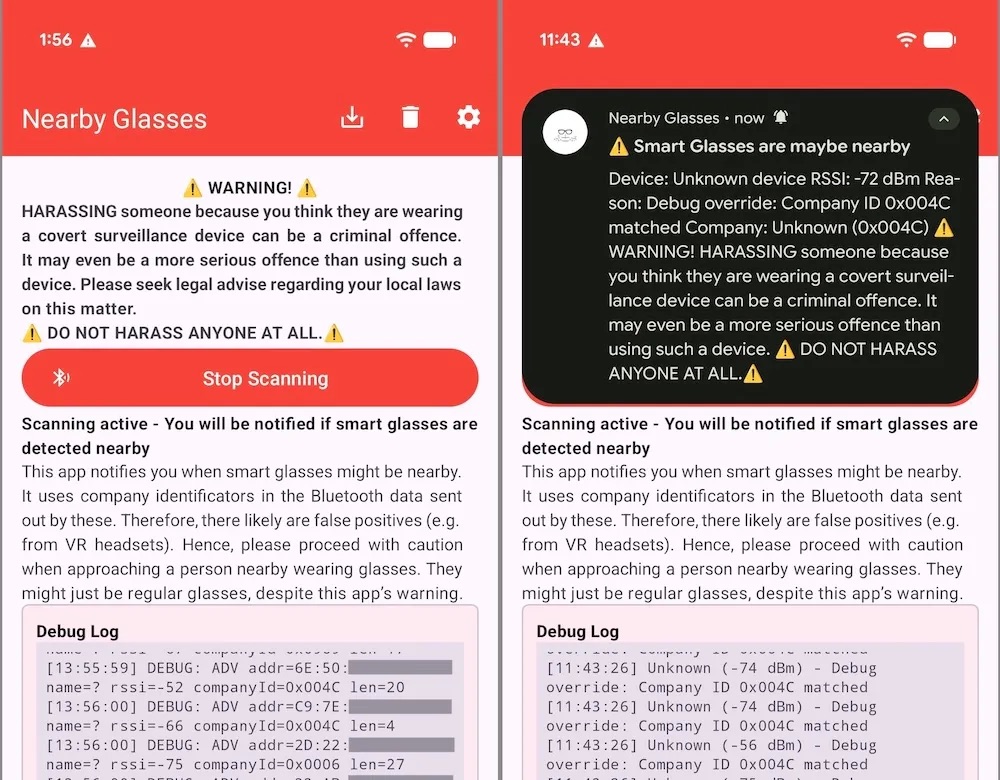
The Nearby Glasses app alerts users to Meta or Snap smart glasses in their vicinity by tracking the Bluetooth signals these devices broadcast. Source
If you’re especially worried about your privacy, installing an app like this is a smart move. It can be particularly helpful for people in high-risk groups, such as stalking survivors, sex workers, or undocumented immigrants.
For those who aren’t quite ready to go full-on paranoid, we highly recommend setting your Meta accounts to private. Granted, this won’t stop smart glasses from capturing your face, and it’s not a foolproof shield against potential recognition. However, restricting access to your photos, contact lists, and other personal details helps cut down on the data that could potentially be weaponized to identify you and map out your digital footprint.
If you’re not sure how tight your social media security actually is, we recommend checking out our free online tool – Privacy Checker. It gives you step-by-step instructions on how to tune your privacy and security settings across different social networks and online platforms, helping you shrink the amount of personal info floating around out there for strangers to see.

 Tips
Tips